




Quick recap
The meeting began with introductions and discussions about a collaborative online international learning program in economics between the University of Southeastern Philippines and Universitas Brawijaya, which aims to foster cross-border collaboration and develop global competencies. Multiple student groups presented research findings on various economic topics including agricultural carbon efficiency, trade impacts, digital agriculture, and regional economic cooperation, with presentations covering methodologies, results, and policy recommendations. The session concluded with testimonials from students about their collaborative experience and discussions about the effectiveness of trade-based measures in combating illegal fishing practices, with plans for future research and cooperation.
Next steps
- USeP_Jennifer: check and review Group 1, 3, and 5 outputs in Google form that were just submitted
- USeP_Jennifer: announce top 3 best review papers later after reviewing all submissions
- USeP_Jennifer: share attendance link in chat room for this afternoon's session
- USeP_Jennifer: share evaluation form after the activity as basis for certificates
- Students : submit accomplishment report per group as ANEX3 including screenshots
- Students : create one-minute video testimony about the program
- Group members: answer additional questions typed in chat box directly
- USeP_Jennifer and UB_Lina: work on MOU processing through their respective OIA offices for future collaborations
- USeP_Jennifer and UB_Lina: announce winners of best review paper and best presentation next week via video
- USeP_Jennifer: conduct evaluation period next week
Summary
Agricultural Carbon Efficiency and Trade
The discussion focused on agricultural carbon efficiency and trade impacts, with Noland presenting research findings using the MomQuest Productivity Index. The study showed improvements in carbon efficiency over time but identified gaps in research, particularly regarding fertilizers and pesticide use. The research concluded that trade can promote cleaner production through technology spillovers, though China's agriculture sector still produces high emissions despite expanding trade.
ECOL Program Overview Meeting
The meeting began with introductions and a discussion about the status of student outputs in a Google form, with some groups still needing to submit. Professor Lina Asmarwati and Jennifer, representing the University of Southeastern Philippines (USEP), greeted participants and provided an overview of the Economics Celebrities Online International Learning (ECOL) program, a collaboration between USEP and Universitas Brawijaya. They highlighted the program's structure, including the involvement of 30 USEP students and 127 Universitas Brawijaya students, and outlined the main activity, which involves a literature review of economic journals. The session concluded with plans to start presentations, with Dr. Ivey V. Ferzas set to deliver opening remarks.
International Economics Learning Collaboration Launch
The meeting marked the launch of a pilot collaborative online international learning program in economics between the University of Southeastern Philippines and Universitas Brawijaya, with participants engaging in a virtual review session. Dr. Jennifer Law and Dr. Lina Asmara Wahy outlined assessment criteria for journal review papers and presentations, emphasizing creativity, clarity, and analytical skills. The program aims to foster cross-border collaboration, develop global competencies, and promote intercultural exchange, with plans to expand to other courses and subjects in the future.
International Trade and Economic Analysis
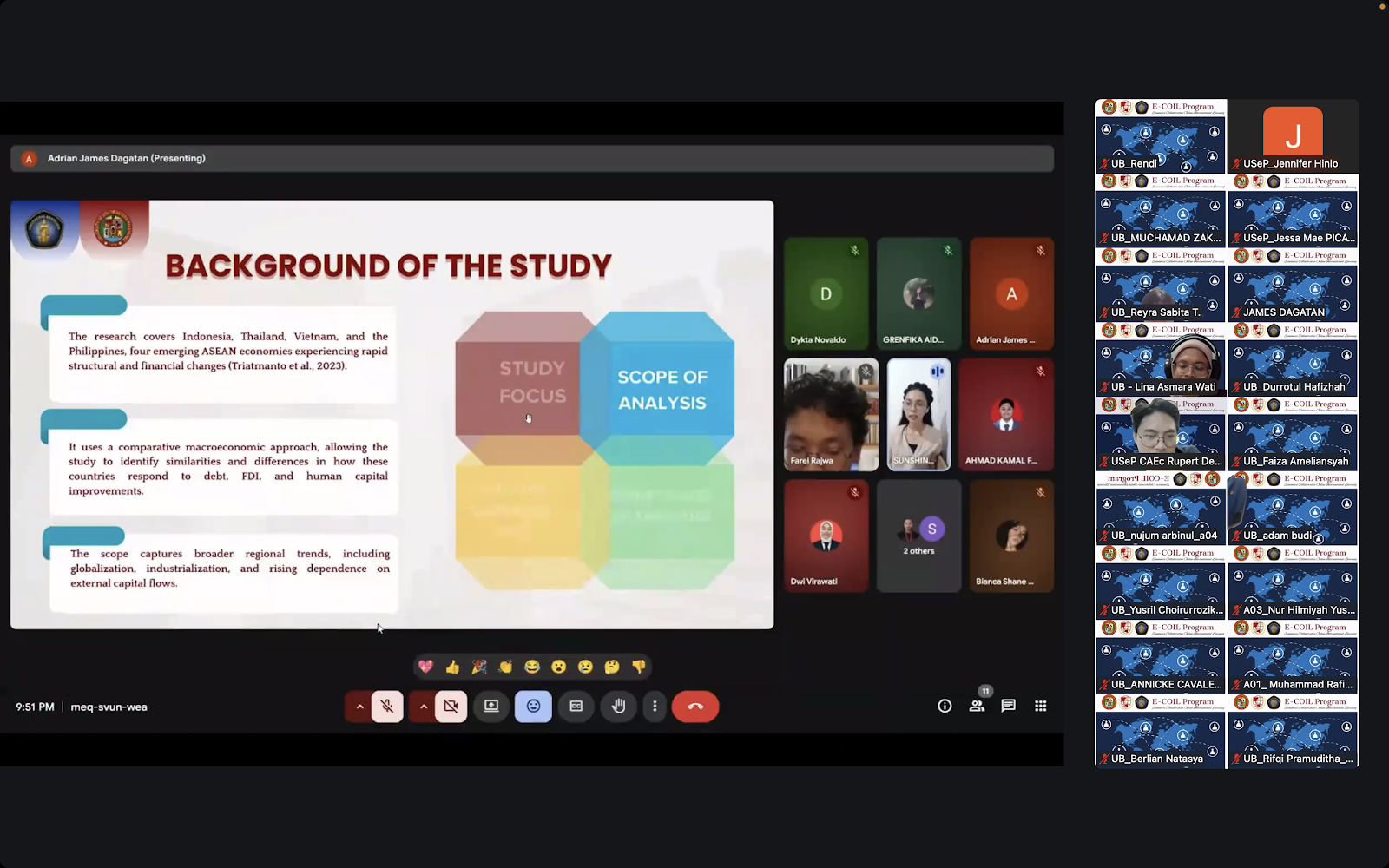
The meeting focused on a collaborative presentation between the University of Southeastern Philippines and Universitas Brawijaya, Indonesia, on international trade and economic topics. The first group presented a literature review on the influence of total external debt, foreign direct investment, and human capital index on economic growth in Indonesia, Thailand, Vietnam, and the Philippines. They used the Panel Vector Autoregressive (PVAR) model to analyze the dynamic relationship between these variables. The second group discussed the impact of international agricultural trade on carbon emission performance in China, using the Malmquist Productivity Index to measure changes from 2005 to 2020. Both presentations highlighted the significance of their findings for policymakers and the need for further research in their respective areas.
Digital Agriculture and Trade Insights
The meeting featured presentations on research topics related to digital agriculture, carbon emissions, and the Regional Comprehensive Economic Partnership (RCEP). The first group presented a study on the spatial spillover effects of digital agriculture on carbon emissions in China, using secondary data from 2000 to 2020. The second group discussed a literature review on RCEP's impact on value-added trade in Asia-Pacific economies, highlighting the importance of accurate measurement through value-added decomposition. Questions were raised about the reliance on secondary data, to which the group explained their intention to explore primary data in future studies. The third group presented a comprehensive analysis of RCEP's effects on trade, emphasizing the need to distinguish between domestic and foreign value-added contributions. They recommended further liberalization and suggested future research on services liberalization and foreign direct investment under the RCEP framework.
CGE Model and Export Definitions
Professor Lina asked Group 3 to prepare questions for future presenters, and Sherry explained the definitions of gross export and gross import from Table 3. Carl Limbaga explained the CGE model, describing it as a simulation of a closed system that calculates new equilibrium after changes. The session concluded with a reminder for students to ask questions during future presentations, and the announcement of Group 4's upcoming presentation on the driving forces of marine fisheries and seafood export in Bangladesh.
Bangladesh Marine Fisheries Export Analysis
The meeting discussed a study on Bangladesh's marine fisheries and seafood exports, focusing on the factors driving these sectors. The research applied an augmented gravity model to analyze key economic, geographic, and policy determinants affecting export performance. The study found that marine fisheries exports are heavily restricted by institutional and regulatory barriers, while seafood exports are more demand-driven. Based on these findings, the researchers provided policy recommendations to strengthen HACCP compliance, realign regional trade agreements with actual export markets, and promote sustainable harvesting and value addition.
Fish Trade Sustainability Across Countries
The meeting focused on a presentation about fish trade and sustainability, with discussions on its applicability to different countries. Eul asked if the study on Bangladesh could be applied to the Philippines or Indonesia, to which Jana provided an answer explaining that while the study's framework could be adapted, country-specific factors would need to be considered due to differences in governance, regulations, and economic conditions. The group also discussed trade-based measures to combat IUU fishing and their effectiveness across developing countries.
Global Fish Trade and Sustainability
The meeting focused on a presentation by Group 5 regarding the impact of global fish trade and governance on long-term stock sustainability, particularly in open access or poorly regulated fisheries. Pearl from USEP provided insights on the effectiveness of trade-based measures like traceability systems and certification schemes in reducing IUU fishing, highlighting challenges such as limited resources and high compliance costs for small fishermen in developing countries. The discussion concluded with a call for UB students from Group 5 to respond to a question about the interaction between global fish trade and governance quality, but time constraints prevented further responses.
Economic Inequality in Fisheries Value Chain
The presentation reviewed a study on economic returns in small-scale fisheries for international markets, highlighting severe inequalities where fishers receive less than 10% of the final export price while middlemen and exporters capture the majority. The research, conducted in Fiji and Kiribati, quantified price markups and income disparities across the value chain, revealing an "hourglass" structure with thousands of fishers at the bottom, 100 middlemen, and 10-20 exporters at the top. The study proposed recommendations for market transparency, collective bargaining, and local value addition, while suggesting future research directions including digital platforms and gender roles in fisheries.
Student Research on Global Trade Impacts
The meeting focused on presentations and discussions from multiple student groups. Group 6 presented on the distribution of economic returns in small-scale fisheries for international markets, highlighting high markups by exporters and proposing digital platforms and blockchain technology for traceability. Group 7 presented an econometric evaluation of the China-U.S. trade war's effects, using advanced panel data techniques to assess trade impacts and policy recommendations. Group 8 was scheduled to present on the effectiveness of ASEAN Plus Alpha regional economic cooperation, but their presentation was not included in the transcript. The conversation ended with questions and clarifications from the audience, particularly regarding the methodology and policy implications of the studies presented.
ASEAN Plus 6 Trade Analysis
The meeting focused on a presentation by Group 8 on the effectiveness of ASEAN regional groupings, particularly ASEAN Plus 3 and ASEAN Plus 6, using a gravity model to analyze trade flows. The study found that ASEAN Plus 6 provided the strongest trade benefits, which was confirmed through sensitivity tests and robustness checks. The group recommended strengthening ASEAN Plus 6 cooperation and promoting deeper economic connections with North Asia. The conversation ended with testimonials from students about their experience in the collaborative program, expressing gratitude for the opportunity to learn and connect with students from Indonesia. Professor Lina expressed hope for future collaborations and mentioned processing an MOU for continued cooperation.


